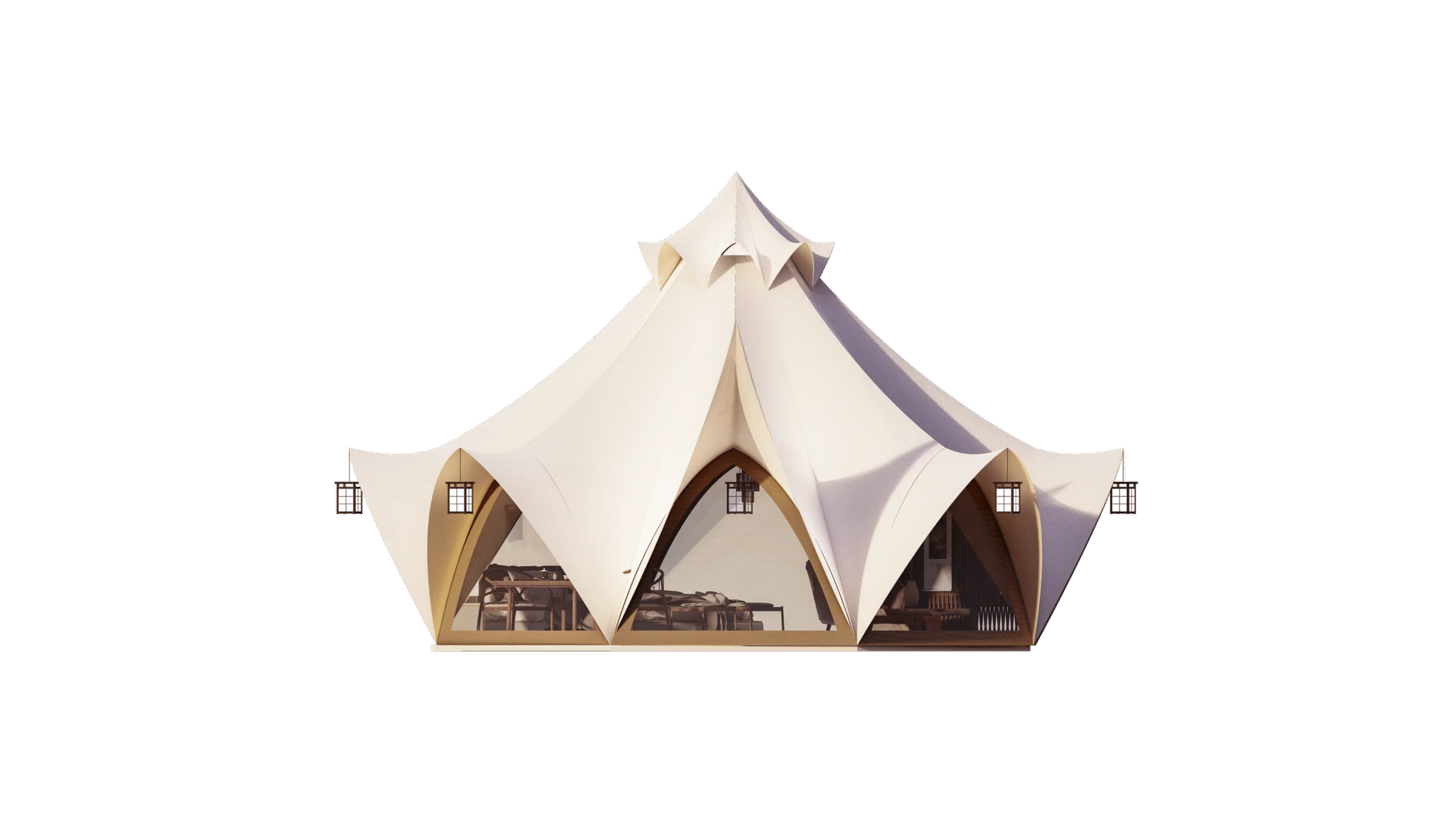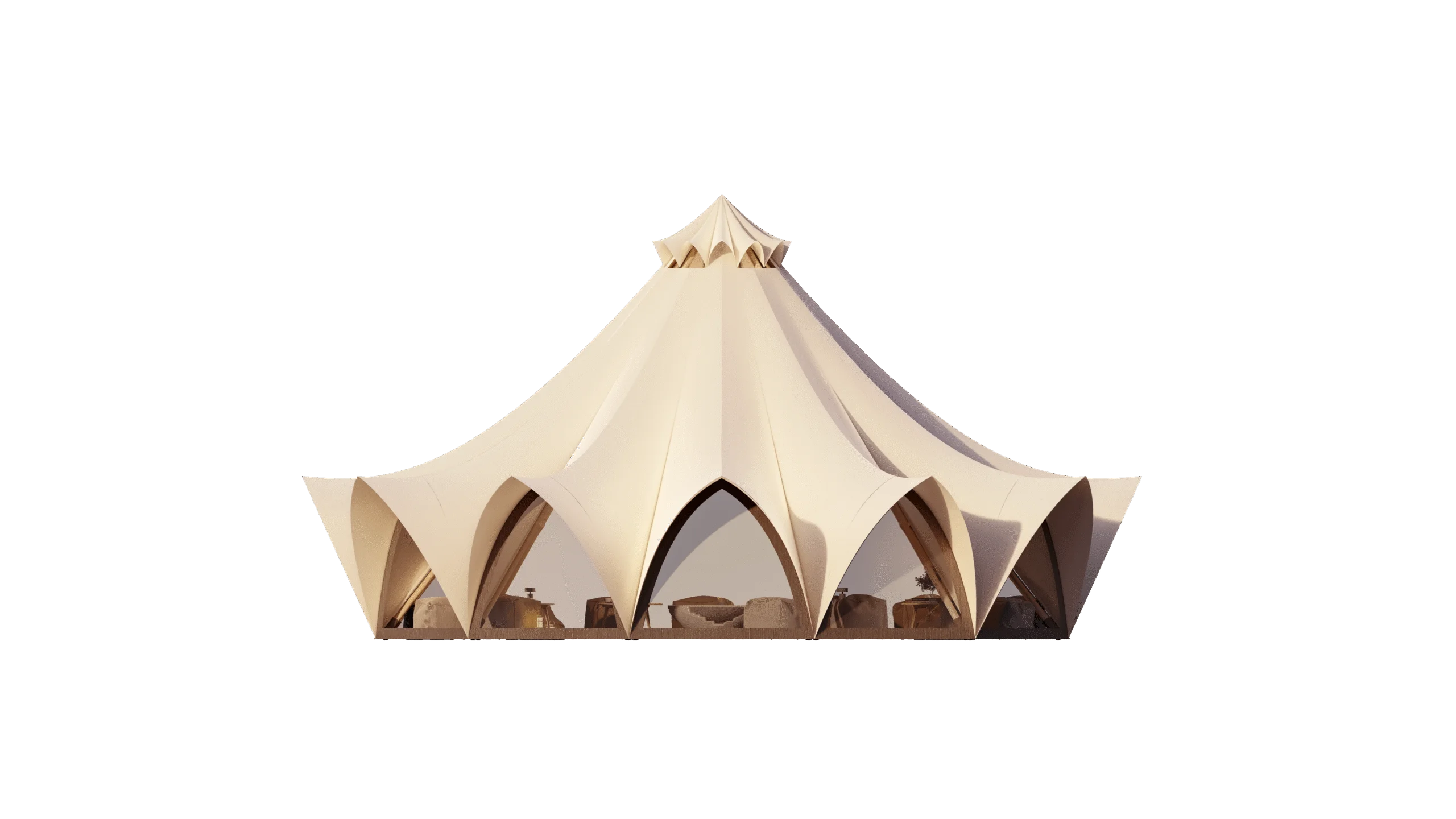
A resort developer on Costa Rica’s Pacific coast buys six budget tent covers at $2,500 each. Eighteen months later, every single one is brittle, faded, and leaking at the seams. The replacement cost is $15,000. The revenue lost while units sit empty during replacement is $44,100.
The developer who spent 20% more on marine-grade acrylic at the outset has not replaced a single cover. That delta defines the 14-hour replacement cycle: storm hits, mold channel spreads, owner waits, replacement order is finally placed, then fabrication and shipping compress the fix into a same-week window no booking calendar can absorb.
The false economy of 400-gram budget covers
Budget covers made from 400-gram material seem like a reasonable saving at the purchasing stage. The initial price tag is lower, and on paper the difference looks modest. But 400-gram fabric lacks the thermal mass to block intense tropical UV radiation. Under Caribbean sun, the material degrades rapidly, turning brittle within 12 to 18 months.
The failure is not cosmetic. Brittle fabric tears in wind. It cracks under tension. It stops repelling water at the seams. And once the fabric loses its structural integrity, the entire cover becomes a write-off. You cannot patch your way out of systemic UV degradation.
Manufacturing expert Ronnie Smith puts the cost gap in stark terms.
“A properly made cover can last for 15 years and often this properly made cover is only costing the client 20 or 30 percent more than the bad quality cover but we’re getting 10 more year lifespan.” — Ronnie Smith, manufacturing specialist
That 20 to 30 percent premium on a $6,000 Hexagome is $1,200 to $1,800 per unit. Over a 10-year operating period, six units with budget covers need five replacement cycles at $15,000 each. That is $75,000 in replacements alone. Six units with marine-grade acrylic spend zero on fabric replacement during that same decade.
Why 750-gram marine-grade acrylic was built for salt and sun
Marine-grade acrylic was not designed for glamping. It was engineered for sailboat covers and bimini tops, equipment that faces the same UV exposure, salt spray, and humidity as a coastal resort tent. The material is solution-dyed, meaning pigment is embedded into the fiber during manufacturing rather than coated onto the surface. Surface-coated fabrics fade. Solution-dyed fabrics hold color for a decade.
At 750 grams per square meter, the fabric provides enough thermal mass to absorb and dissipate tropical UV without transferring heat into the living space. The interior stays cooler. The air conditioning runs less. The guest sleeps through the night instead of waking at 2 AM in a sauna.
The mold channeling disaster that destroys cheap seams
UV is only the first attacker. The second is tropical moisture, and it is more insidious because the damage happens invisibly.
Budget covers use needle-stitched seams. Every stitch hole is a channel. In humid tropical zones, moisture seeps through those channels and into the fiber structure. Once mold colonizes the interior of the fabric, it spreads through the channels like roots through soil. By the time you see surface discoloration, the fabric is already compromised at the structural level.
Ronnie Smith describes the failure mechanism precisely.
“Mold can get into the fibers and it’s like channels in there and it’ll just run all the way up and when it’s up there you’re done.” (Ronnie Smith, manufacturing specialist)
The solution is high-frequency welding. Instead of stitching, the seam is fused into a permanent, watertight bond. There are no needle holes. No channels. No path for moisture to invade. The weld is stronger than the surrounding material, and it will not come undone regardless of the shear stress placed on it.
The hurricane downtime math that kills resort profitability
A cover failure during storm season does not just cost the price of the replacement. It hemorrhages active revenue. At a conservative ADR of $350 per night, one unit offline for a single week bleeds $2,450 in unrecoverable gross revenue. If the replacement takes three weeks because the supplier is backlogged after a regional storm, the loss is $7,350 per unit.
For a six-unit resort, a single storm that damages two covers creates a $14,700 revenue hole before the replacement covers even arrive. And if guests are inside during a leak, the refund exposure compounds the loss.
“You can be pretty sure you’re not going to have people blown away during a storm.” (Louis, structural engineer, on 280 km/h rated frames)
Premium structures engineered for 280 km/h winds with galvanized steel skeletons survive the storms that destroy budget builds. The cover stays intact. The unit stays online. The revenue keeps flowing.
The 6-unit fleet cost comparison over 10 years
The numbers do not lie. Here is the 10-year total cost of ownership for a six-unit resort in a tropical coastal market:
Budget covers ($2,500 each, 18-month lifespan):
- Initial purchase: $15,000
- Replacements (5 cycles × $15,000): $75,000
- Downtime revenue loss (conservative 2 weeks per cycle, 2 units per event): $42,000
- Refund exposure (2 incidents per cycle): $19,200
- 10-year total: $151,200
Marine-grade acrylic ($8,500 per unit with frame, 10+ year lifespan):
- Initial purchase: $51,000
- Replacements: $0
- Downtime revenue loss: $0
- Refund exposure: $0
- 10-year total: $51,000
The budget path costs $100,200 more over a decade. The savings you thought you were getting at the purchasing stage vanish by year three, and then they compound destructively for seven more years.
The pre-season fabric audit every coastal resort should run
Before each high season, walk your fleet with a flashlight and a towel. Check four critical zones:
- Roof-to-wall seam: Run the flashlight along the interior seam line. Any light bleeding through is a future leak.
- Window frames: Press the towel against the fabric around each window. Dampness means the seal is failing.
- Door overlap: Spray a hose at the door closure from 3 feet away for 60 seconds. Any water inside means the overlap is insufficient.
- Ventilation flaps: These are the highest-risk penetration points in tropical rain. Check that the flap still seats firmly against the fabric with no gap.
This 10-minute per unit audit catches failures before guests do. A caught leak costs $200 to reseal. A guest-discovered leak costs $4,800 in refunds and brand damage.
The wet-season operations manual your staff needs
Tropical storm season runs May through November in Costa Rica and the Caribbean. Your operations team needs three protocols ready before the first named storm forms:
Daily monitoring (May to November): Check tension on every cover by 7 AM each morning. Tropical humidity overnight can loosen anchor points. A 5-minute walk with a torque wrench prevents the slack that turns into a tear at 60 mph.
Storm protocol (named storm approaching): Tension all covers to maximum specification. Secure all loose hardware, furniture, and anything that could become a projectile within 30 feet of the structures. Cap water and utility connections. Brief guests on wind ratings and indoor safety positions.
Post-storm inspection (within 24 hours): Walk every unit with a flashlight. Check for water ingress at the four seam zones. Look for ice-dam equivalents, debris trapped in fabric folds that hold moisture against the surface. Re-tension any cover that shifted during the storm. Document damage with photos for insurance and manufacturer warranty claims.
These three protocols cost nothing to implement and protect $100,000+ in annual revenue across a six-unit fleet.
FAQ
How long do marine-grade acrylic covers really last in tropical conditions? With proper tensioning and high-frequency welded seams, marine-grade acrylic covers routinely last 10 to 15 years in tropical coastal environments. The 750-gram fabric provides sufficient UV resistance to maintain structural integrity across hundreds of storm cycles.
What makes 400-gram fabric fail so quickly in Costa Rica? The combination of intense UV radiation, constant humidity, and salt air degrades thin fabric from both sides simultaneously. UV makes the exterior brittle while humidity and mold attack the interior through needle-stitched seam channels. In tropical zones, this dual attack destroys 400-gram covers within 18 months.
Is the 20% premium for marine-grade acrylic worth it? A 20% premium on a $6,000 unit is $1,200. Over 10 years, six budget units require $75,000 in replacement costs alone. The marine-grade units require zero fabric replacement. The premium pays for itself within the first 18 months and then saves money every year after that.
What wind rating should coastal glamping tents have? Structures in hurricane-prone regions like Costa Rica and the Caribbean should be engineered for at least 280 km/h winds. This requires galvanized steel skeletons with reinforced connection points. Budget frames that flex beyond their design limit transfer stress to the fabric, causing tears that cascade into total cover failure.
How do I test my existing covers before storm season? Run the four-zone audit: flashlight along roof-to-wall seams, towel press on window frames, hose test on door overlaps, and ventilation flap seating check. Ten minutes per unit catches failures before guests discover them. A proactively caught leak costs $200 to fix. A guest-discovered leak costs $4,800 in refunds.
What will your first step be to tighten your wet-season inspection protocol before the next rainy cycle?
Other formats: FAQ Version → · Structured Data →