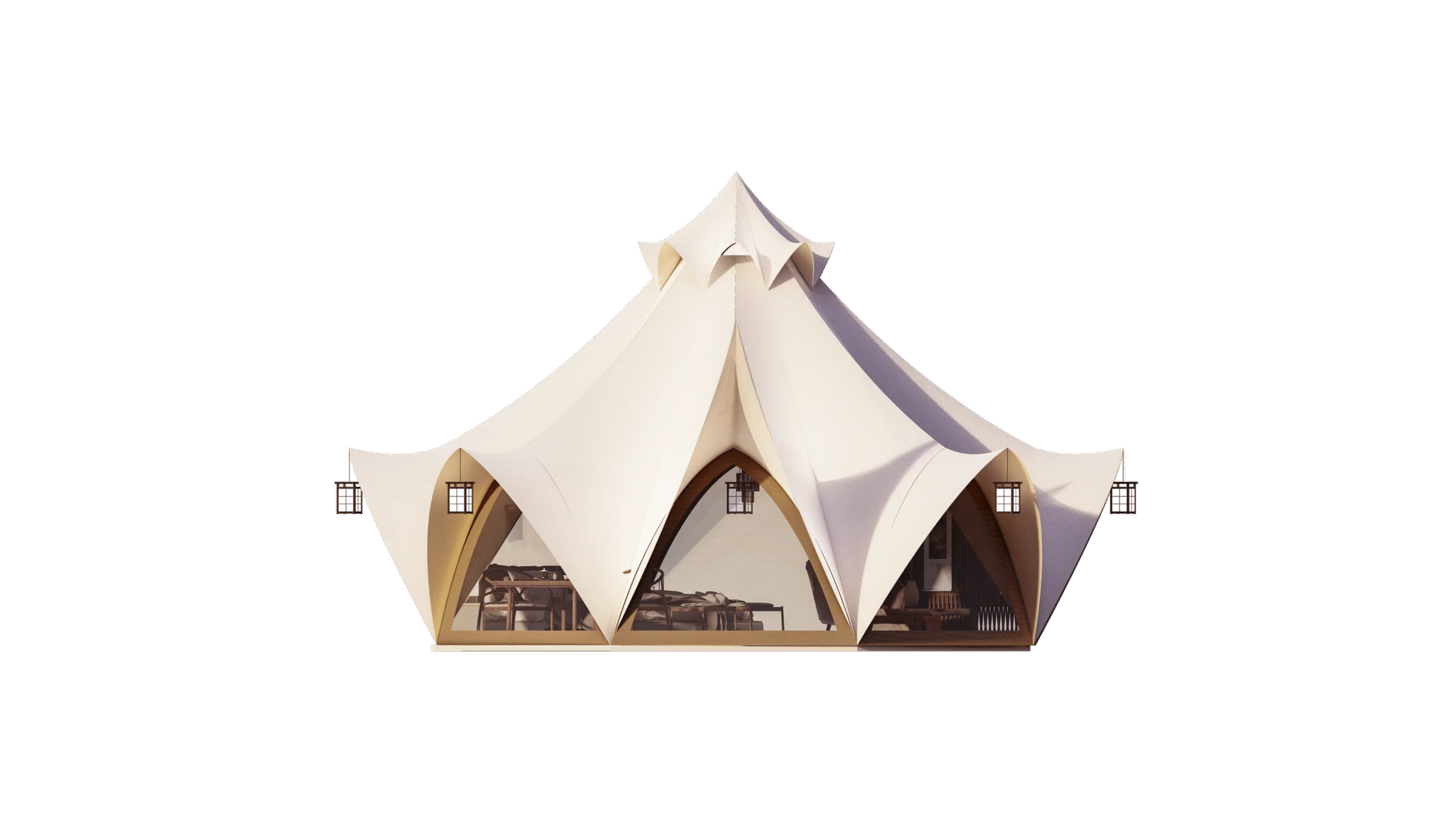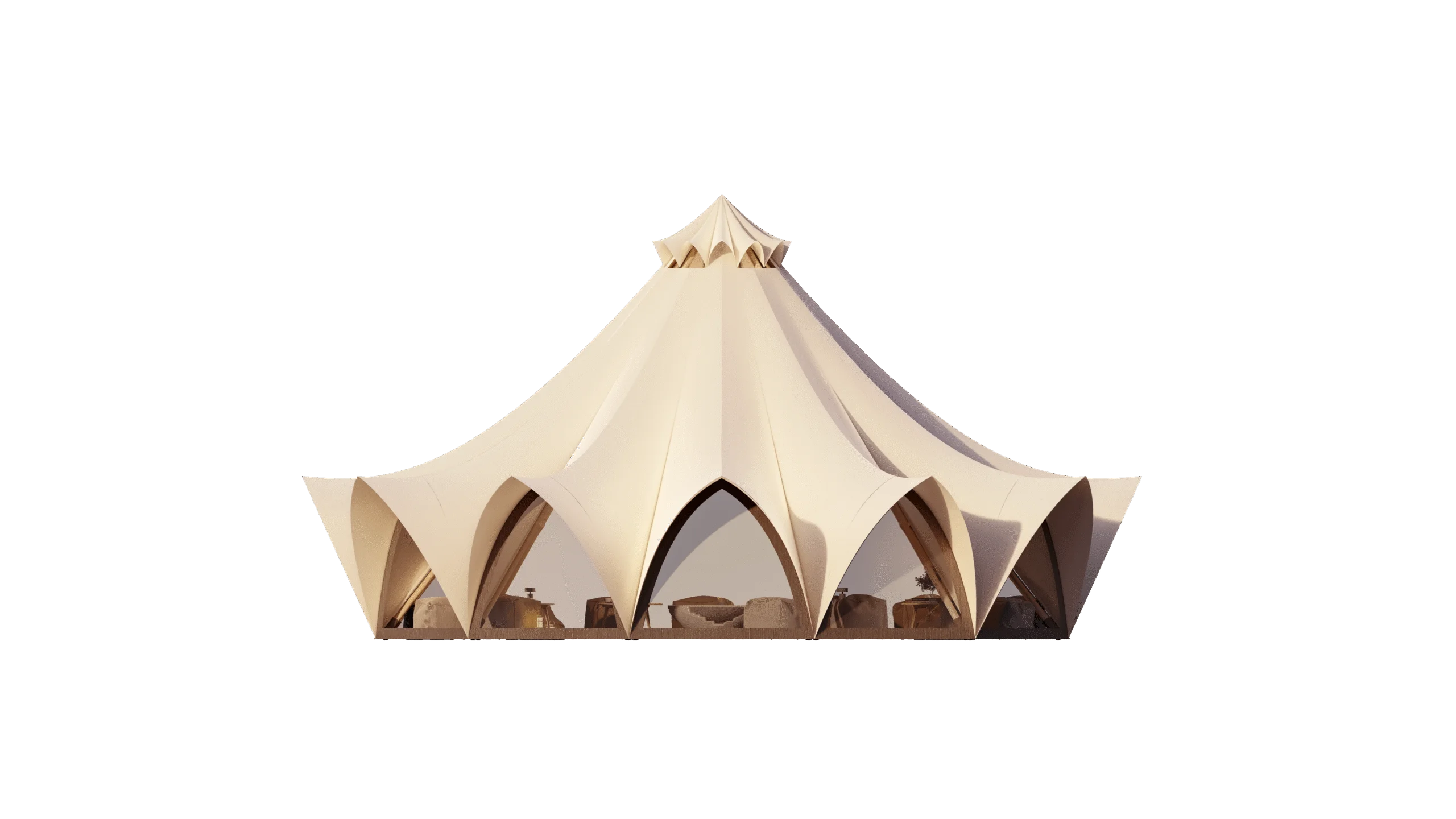
Tulum, six months post-install: A developer called. Twelve Hexagome units on a beachfront dune. Frames fine. Fabric delaminating at seams where salt-laden wind funneled between structures. No marine-grade coating budgeted. Retrofit cost $47,000 — exceeded the $38,000 original install.
This pattern repeats across every region we serve. The same modular tent that thrives in a protected jungle clearing fails on an exposed ridge or a flood-prone riverbank. Modular glamping tents are not one-size-fits-all.
Matching the system to actual site conditions—wind load, salt exposure, snow load, seismic zone, soil bearing capacity, drainage—is the single highest-leverage decision in a glamping build. Yet it’s routinely made on aesthetics or price, not engineering. 87% of retrofit calls we field trace to one of five skipped site-data points.
Below is the framework we use with every resort developer before a single anchor goes in the ground.
The Site-Condition Matrix: Five Non-Negotiable Data Points
Before selecting a tent model, you need five numbers. Skip any one and you’re guessing.
| Factor | What to Measure | Why It Changes the Spec |
|---|---|---|
| Design wind speed | ASCE 7 / local code basic wind speed (mph or km/h) at 33 ft height, Exposure Category B/C/D | Determines frame gauge, anchor density, bracing pattern |
| Salt exposure zone | Distance from breaking surf; ISO 9223 corrosivity category (C1–C5) | Dictates frame coating (epoxy vs. hot-dip galvanized vs. marine-grade), fastener grade (304 vs. 316 stainless), fabric treatment |
| Ground snow load | ASCE 7 ground snow load (psf or kN/m²) | Drives roof pitch, membrane tension, structural bracing, snow-shed geometry |
| Seismic design category | ASCE 7 SDC A–F based on S₁ and Sₛ | Affects anchor flexibility, frame ductility, connection detailing |
| Soil bearing & drainage | Geotech report: allowable bearing pressure (psf/kPa), seasonal water table, percolation rate | Sets foundation type (helical piers, concrete pads, driven piles, ballasted frames) and moisture barrier strategy |
If your architect or contractor can’t produce these five numbers, stop. You don’t have a site—you have a hope.
Coastal & Beachfront: Salt, Sustained Wind, Soft Ground
Typical conditions: Exposure Category D, ISO 9223 C4–C5, design wind 130–180 mph, sand/loose fill, high water table.
What fails first: Untreated hardware corrodes in 18–24 months. Standard anchors pull out of sand at half their rated capacity. Fabric UV degradation accelerates under salt crust.
Enchantents spec for this zone:
- Frame: Hot-dip galvanized + marine epoxy topcoat (Simetrix Coastal package) or 316L stainless frame option
- Anchors: Helical piers minimum 10 ft embedment, or engineered ballasted frames with geotextile skirt
- Fabric: Ferrari Précontraint 502V or 702V with PVDF topcoat, welded seams only (no stitching in salt zone)
- Ventilation: High-low passive stack with corrosion-proof mesh—no mechanical HVAC dependency
- Geometry: Octagome or Decagome—wider base, lower center of gravity, aerodynamic profile sheds wind
Real project: Costa Rica, Nicoya Peninsula. Eight Octagome units, 50 m from high tide line. Installed 2023. Zero corrosion findings at 18-month inspection. ADR holding at $420/night.
Mountain & Alpine: Snow Load, Freeze-Thaw, Seismic
Typical conditions: Ground snow load 40–120 psf, SDC C–E, rocky/shallow soils, temperature swing -20°C to +30°C.
What fails first: Insufficient roof pitch traps snow → membrane puncture or frame collapse. Rigid anchors fracture in seismic events. Condensation rots untreated timber decks.
Enchantents spec for this zone:
- Frame: Upsized structural tubing (Simetrix Alpine package), additional diagonal bracing at 45°
- Roof: Minimum 3:12 pitch on all models; Decagome and Dodecagome include integrated snow-shed channels
- Anchors: Flexible base plates with neoprene isolation pads; helical piers with seismic-rated brackets
- Floor system: Raised composite deck on adjustable pedestals—thermal break, drainage plane, no ground contact
- Fabric: Insulated double-membrane option (R-8 equivalent) for year-round operation
Real project: Utah, Wasatch Range. Six Decagome units at 8,200 ft. Ground snow load 85 psf. Operated through 2023–24 winter (record 142″ seasonal snow). Zero structural incidents. Occupancy 88% January–March.
Jungle & Rainforest: Humidity, Biomass, Uneven Terrain
Typical conditions: Exposure Category B, 120″+ annual rainfall, organic soils, steep slopes, termite/ant pressure.
What fails first: Mold/mildew on fabric interior. Ground moisture wicks into floor systems. Organic debris clogs drainage. Insects penetrate untreated mesh.
Enchantents spec for this zone:
- Frame: Hot-dip galvanized standard (C3 coating sufficient); optional boron-treated timber deck substructure
- Floor: Raised minimum 24″ on helical piers with vapor barrier skirt; composite decking with ¼” gap drainage
- Fabric: Anti-microbial treatment (Sanitized® AG), hydrophobic topcoat, fine-mesh (no-see-um) at all openings
- Drainage: Perimeter French drain integrated into pier layout; gutter-to-tank rainwater harvest standard
- Geometry: Hexagome and Octagome—modular footprint adapts to clearing boundaries without tree removal
Real project: Quintana Roo, Mexico. Fifteen Hexagome units in secondary growth jungle. Installed 2022. Zero mold claims. Guest comfort scores 4.8/5 on humidity management.
Desert & Arid: UV Extremes, Thermal Cycling, Sand Abrasion
Typical conditions: UV index 11+ year-round, diurnal swing 40°F+, abrasive sand storms, minimal rainfall.
What fails first: Fabric embrittlement and color fade. Thermal expansion fatigues frame connections. Sand ingress jams zippers and ventilation.
Enchantents spec for this zone:
- Fabric: Ferrari Soltis 86 or 92—high UV stability, openness factor 5–10% for airflow without sand ingress
- Frame: Standard HDG sufficient (C2 coating); connection hardware Loctite 243 + lock nuts for vibration
- Ventilation: Fixed louvered vents with sand-trap baffles; no moving parts
- Foundation: Shallow concrete pads with epoxy-coated rebar—fast install, no heavy equipment
- Color strategy: Light-colored membrane (reflects IR) + dark frame (hides dust)
Real project: Baja California Sur. Four Pentagome units. Installed 2021. Fabric tensile retention 94% at 3-year test. Operating 11 months/year.
The Cost of Getting It Wrong
| Mismatch | Typical Remediation Cost | Revenue Loss During Fix |
|---|---|---|
| Undersized anchors in sand | $8,500–$15,000/unit (helical pier retrofit) | 60–120 days offline |
| Standard coating in salt zone | $12,000–$22,000/unit (frame replacement) | 90–180 days offline |
| Insufficient snow bracing | $18,000–$35,000/unit (structural retrofit) | Full season loss |
| No vapor barrier in jungle | $5,000–$9,000/unit (deck replacement) | 30–60 days offline |
| Wrong fabric in desert | $3,500–$6,000/unit (membrane replacement) | 21–45 days offline |
Compare to upfront spec delta: Coastal package adds 12–18% to unit cost. Alpine package adds 15–22%. Jungle package adds 8–12%. Desert package adds 5–8%.
The math is unambiguous. Spec for the site upfront, or pay 3–5× later with revenue stopped.
How We Run This With You
- Site intake call (30 min): You share location, topography, climate zone, target opening date.
- Data request: We send a one-page checklist for the five matrix factors above. Your geotech/structural engineer fills it.
- System recommendation: We return a marked-up spec sheet—model, package, anchor plan, foundation type, fabric, ventilation, timeline.
- Design review: Your architect reviews against local code. We iterate once (included).
- Production queue: Locked spec enters manufacturing. 8–12 week lead time standard.
No guesswork. No “we’ll figure it out on site.” No surprises at first storm.
Your Next Step
If you’re in feasibility or early design for a modular glamping project, send us the five matrix factors. We’ll return a system recommendation within 48 hours—no obligation.
The cost of the call is zero. The cost of the wrong spec is everything you’ve built.
Enchantents builds modular glamping systems engineered for where they actually live. Simetrix Collection: Quatin, Pentagome, Hexagome, Octagome, Qualan, Decagome, Dodecagome. Mandala Collection: Orb, Vesica, Torus. Five-year warranty on permanent installations. Manufacturing: Querétaro, Mexico. Shipping worldwide.