
Derry Green had a problem.
His Secret Garden Glamping site had gone viral, 44,000 people on the waiting list, units selling out in 47 minutes, and the fabric was already showing mold. Eighteen months in. The British climate had eaten through the cheap imported covers faster than anyone expected. Six replacement units: $15,000. Three weeks of lost bookings during peak season: $50,400. That one material decision cost him more than a Category 2 hurricane would have.
Most first-time developers refuse to run this math. They see a 400g polyester cover at $1,200 next to a marine-grade acrylic cover at $2,800 and pick the cheaper one. Then they replace it twice more in five years. Lose three weeks of revenue each time. And still end up buying the premium fabric anyway.
Cheap fabric does not save money. It costs more than storm damage.
The three-year replacement cycle that eats your profit
UV hits it. The coating cracks. The fabric yellows. Mold moves into the gaps where the coating flaked away.
In Costa Rica, Mexico, the Caribbean (anywhere tropical) this process runs twice as fast. A cover that lasts 36 months in Wales dies in 18 to 24 months in the Yucatan.
“We replaced our entire fleet of covers in year two, then again in year four. The third replacement was the one where we finally bought the proper material. By then we had spent more on replacements than the entire original tent purchase.” — Resort operator, Tulum, Mexico (2025 industry interview)
Now the math. A six-unit resort at $400/night, 60% occupancy, generates $7,200 per month per unit. A three-week shutdown for fabric replacement: $5,040 per unit in lost bookings. Six units: $30,240 stranded per cycle. Add the replacement covers themselves, $7,200 for six 400g units, and each cycle costs $37,440.
Two cycles in five years: $74,880.
That figure exceeds the cost of hurricane damage for most Category 1 and Category 2 storms. A typical Caribbean storm event causes $8,000 to $25,000 in damage to a six-unit site (broken hardware, torn screens, water intrusion). The fabric replacement cycle costs three to nine times more.
Why marine-grade acrylic does what cheap fabric cannot
Marine-grade acrylic was not invented for glamping. It was engineered for sailboat covers and bimini tops, equipment that sits in open ocean under continuous UV bombardment, salt spray, and driving rain for a decade or more.
The secret is solution dyeing. Pigment gets embedded inside the acrylic fiber during manufacturing. Not painted on the surface. UV rays cannot bleach what is built into the fiber.
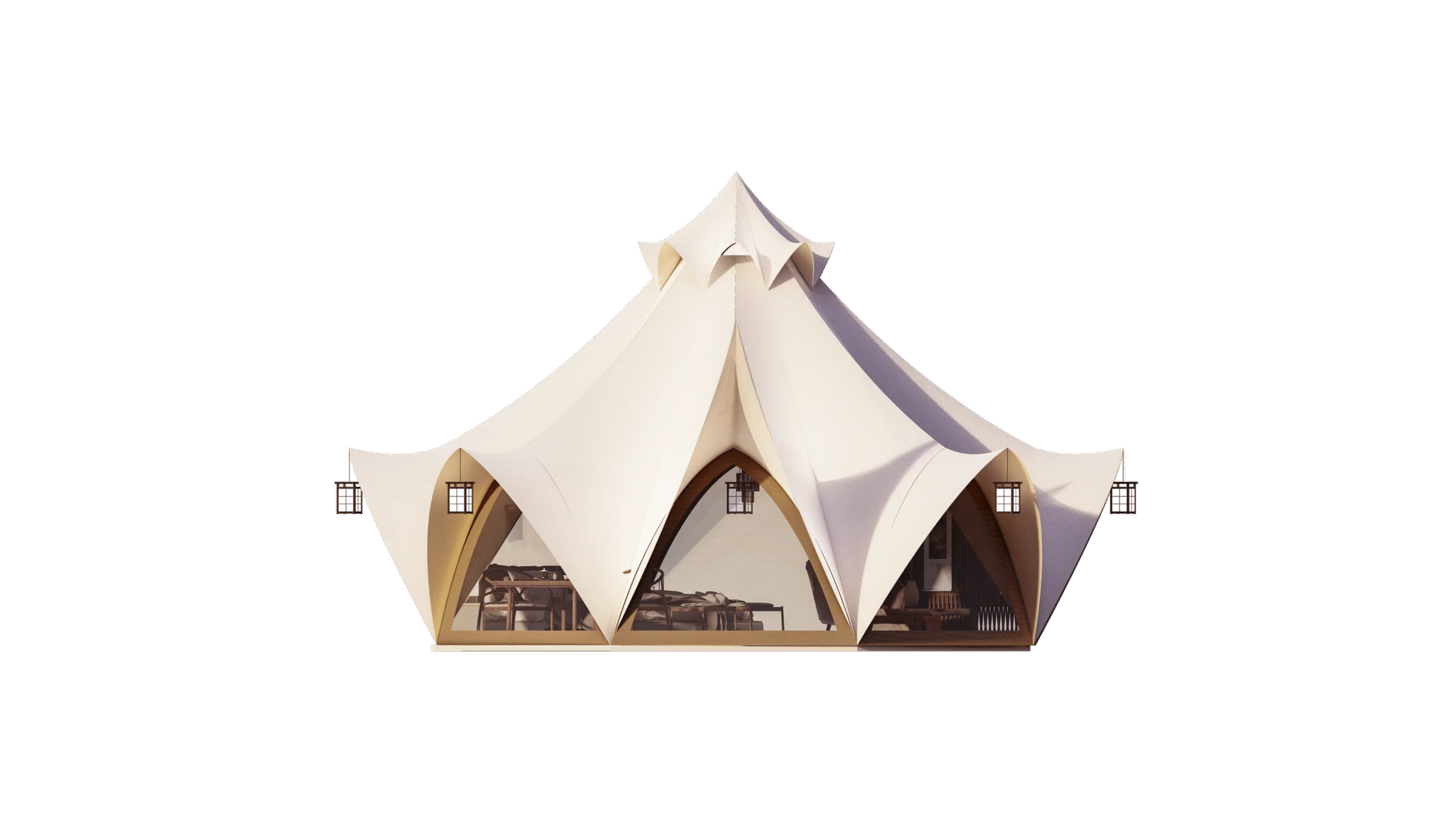
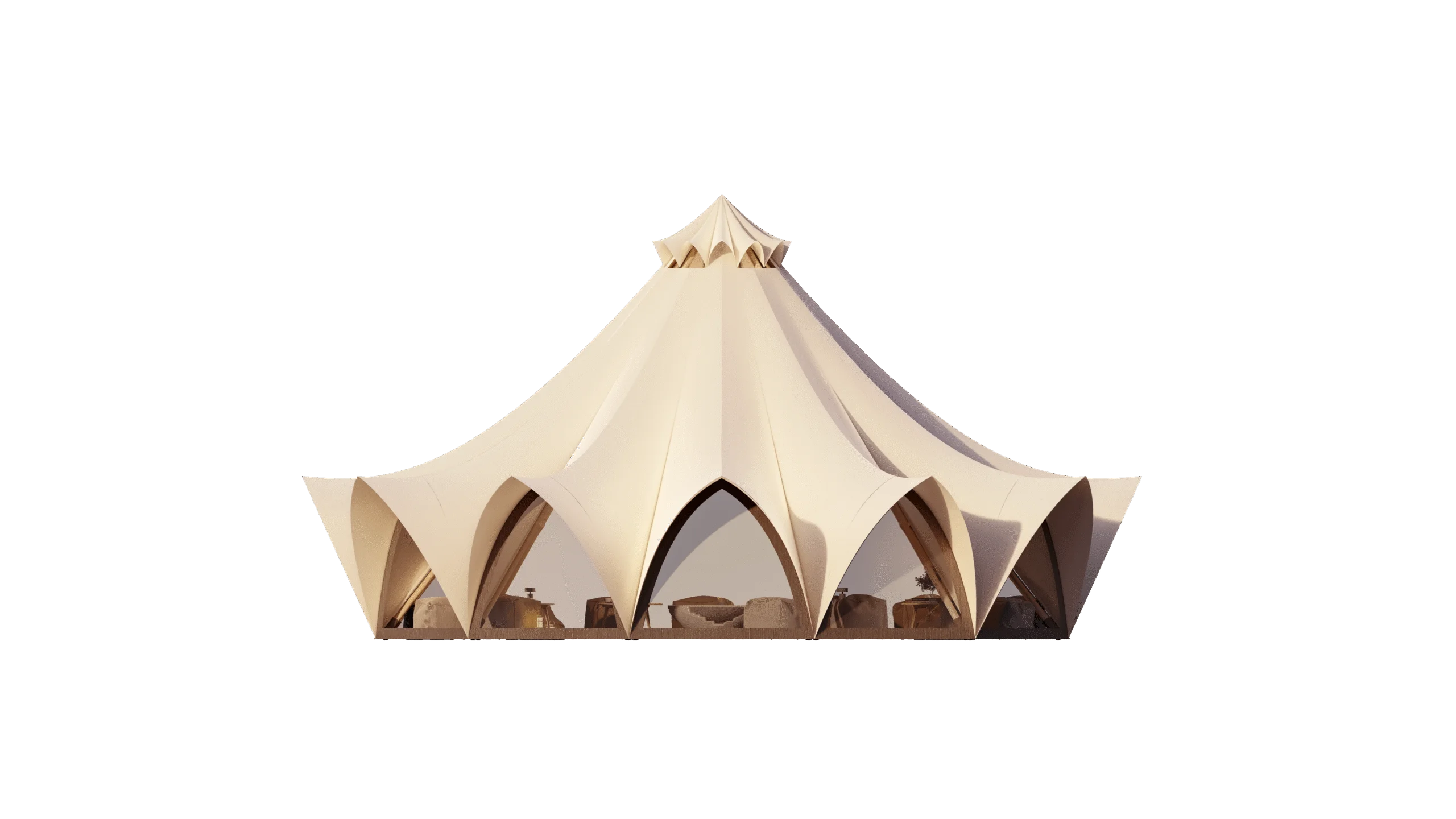
Enchantents uses this material across its Simetrix Collection because it already proved itself in conditions harsher than any glamping site. An Octagome at $8,500 with marine-grade acrylic covers maintains structural integrity and visual appeal for 15 years. A comparable unit with 400g polyester at $6,300 needs three to five cover replacements in the same period. The cheaper unit ends up costing $18,900 to $25,500 in total fabric expenditure over 15 years, more than double the premium unit.
Then there are the seams. Enchantents uses NASA-grade Tenara thread for all seam construction. Tenara does not degrade under UV rays, period. It outlasts the fabric around it. On cheap covers, seams are heat-sealed or stitched with standard thread that rots in humidity. Seam failure is usually the first point of water intrusion, and the most expensive to repair, because it means removing the entire cover.
The $75,000 decade
Let us run the full ten-year comparison for a six-unit resort. The purchase price turns out to be the least important number.
Scenario A: 400g polyester covers (cheaper purchase price)
- Initial cover set: $7,200 (six covers at $1,200 each)
- Replacement cycles: 4 (at years 2, 4, 6, 8) = $28,800
- Lost revenue per replacement cycle: $30,240 × 4 = $120,960
- Hardware damage from degraded covers (water intrusion, frame corrosion): $12,000
- Ten-year total: $168,960
Scenario B: Marine-grade acrylic covers (higher purchase price)
- Initial cover set: $16,800 (six covers at $2,800 each)
- Replacement cycles: 0
- Lost revenue from fabric-related shutdowns: $0
- Hardware damage from water intrusion: $0
- Ten-year total: $16,800
$152,160 over a decade. That is the difference between a resort that generates strong owner returns and a resort that bleeds capital on preventable maintenance.
Even with a single hurricane event during that decade (say $20,000 in damage across both scenarios), the math still favors premium fabric. The hurricane is a one-time cost. The cheap fabric is a recurring tax.
What to ask your manufacturer before you buy
Five questions. Accept nothing less than specific, verifiable answers.
- What is the fabric weight in grams per square meter, and what is the UV resistance rating? Anything below 280g with no UV rating is decorative, not structural. Marine-grade acrylic starts at 280g with a minimum 1,500 UV-hour rating.
- How are the seams sealed: heat sealing, standard stitching, or Tenara thread? Standard thread rots. Heat-sealed seams delaminate. NASA-grade Tenara thread does not degrade under UV and outlasts the fabric itself.
- What is the proven lifespan of this specific fabric in tropical conditions? Demand a manufacturer warranty with a specific year count, not vague claims about “durability.”
- What does a replacement cover cost, and how long does installation take? If the manufacturer cannot quote a replacement price immediately, the supply chain is not reliable.
- Has this fabric been tested to ASTM standards for water resistance and UV exposure? ASTM D4799 (UV exposure) and ASTM D751 (water resistance) are the baseline. No test data means no accountability.
The real hurricane preparation nobody talks about
Resort developers in hurricane zones spend real money on wind-rated frames, anchoring systems, and storm protocols. These are important.
But the single most impactful hurricane preparation is fabric that does not fail during the storm and does not need replacement after it.
A marine-grade acrylic cover on an Octagome with hurricane-rated anchoring survives Category 3 winds with the cover intact. The same frame with a degraded 400g cover? The cover goes. And with it, the interior finishes, the mattress, the bathroom fixtures. The replacement cost escalates from a cover swap to a full unit refurbishment, $5,000 to $8,000 per unit.
Derry Green eventually solved it. After the mold crisis, he switched to premium materials and has not replaced a cover since. His 44,000-person waiting list exists partly because his units still look immaculate years after installation. Guests see quality. Booking revenue confirms it. The material choice was not an expense.
It was the foundation of the brand.
The revenue-at-stake audit you should run this week
Before the next rain season, walk your property with a flashlight and a notepad.
Check the four seam zones on every unit: roof-to-wall junction, window frame edges, door overlap flaps, ventilation ports. Run your hand along each seam interior. Stiffness? Discoloration? White residue? Mold is already colonizing from inside the waterproof membrane.
Then calculate your exposure. Nightly rate × occupancy × 21 days = shutdown cost per unit. Multiply by the number of units showing early degradation. Three of six units showing seam stiffness and discoloration? That is $15,120 in imminent booking losses, plus $3,600 in replacement covers if you stay with cheap fabric, or $8,400 if you upgrade to marine-grade acrylic.
The upgrade pays for itself in the first avoided replacement cycle. Three marine-grade acrylic covers at $8,400 versus three replacement cycles of 400g plus lost revenue at $37,440 per cycle. The premium material saves $29,040 the very first time it prevents a shutdown. Every cycle after that is pure savings.
Derry Green’s mold discovery happened during a routine walkthrough. He noticed stiffness near the door overlap and thought it was just condensation. Two weeks later, mold had spread to three of his twelve units. A third of his property shut down during peak season. Had he audited the seams earlier and switched before the mold took hold, the entire crisis would have been avoided.
Frequently Asked Questions
Q: How much does cheap glamping fabric really cost over ten years? A: A six-unit resort using 400g polyester covers spends approximately $168,960 over ten years when you include four replacement cycles, lost booking revenue during shutdowns, and hardware damage from water intrusion.
Q: What makes marine-grade acrylic different from standard glamping fabric? A: Solution dyeing, pigment embedded inside the fiber during manufacturing, not painted on the surface. UV rays cannot bleach the color. Originally engineered for ocean sailboat covers facing continuous UV, salt, and rain for 10+ years.
Q: How much revenue does a fabric replacement shutdown cost per unit? A: $5,040 per unit for a three-week shutdown at $400/night with 60% occupancy. Across six units: $30,240 per replacement cycle.
Q: Does premium fabric survive hurricane conditions better? A: A marine-grade acrylic cover on a hurricane-rated frame survives Category 3 winds intact. The same frame with degraded 400g polyester may lose the cover entirely, exposing interiors to water damage costing $5,000 to $8,000 per unit.
Q: What ASTM standards should I verify before buying glamping tents? A: ASTM D4799 (UV exposure) and ASTM D751 (water resistance). No test data means no accountability.
What will your first step be to audit your existing fleet before the next storm season?
Other formats: FAQ Version → · Structured Data →